After next week, when I'll be in Fredericton (New Brunswick, obvs), I'll be spending a lot of time in the Northern Peninsula. I just spoke with a woman from Conche, where I'll stay for the first week. It was our second conversation; the first ended with me uncertain about whether she understood that I wanted to stay in her basement apartment. She's L, for lady.
Me: I called you before about staying in your apartment?
L: Oh, yes, I knows.
Me: Great - do you have a room for June 6?
L: Oh yeah. You want to rent for the mon?
Me: [what is a mon?] Oh, no, just the week, I don't need it for the month.
L: Okay. I t'ink yer young and all, so I t'ought you'd like it for the mon. It's cheaper.
Me: That's okay, I'll just be there for a week.
L: You gots a dog, right?
Me: yeah, he's a nice one.
L: I'd like to take him fer walks.
Me: Great, yes, that would be excellent.
L: OH! Deyre's an iceberg out da window.
Me: That's wonderful! It must be beautiful!
L: No. We t'inks dey're ugly. You would t'ink dey're beautiful, 'cause you've not seen 'em.
Me: Yeah, only in pictures. I think they're beautiful, though.
L: Well, bring yer camera.
Me: What's your address?
L: [laughs] They's no address.
Me: So I just show up and ask for where L lives?
L: Yeah, dat's what you do. It's a small town. You'll like it. Quiet [pronounced "quite"] and peaceful.
So that's where I'll be, Conche.
Friday, May 27, 2011

Friday, May 13, 2011
The Story of Marvin, Part II
Marvin continued walking away from the ship, across the spongy, green ground. So many smells! Such colors! His tail wagged so vigorously that his whole body moved back and forth as he ran from smell to smell, taking the world in through his nose. He reached fast-flowing water and stopped in wonder. It was endless! He drank from it until he thought he would burst, then lay down for a while next to it, his face in a pile of rotting vegetation.
After some time, he realized how hungry he was. What would he do without the people and the cat-queens? He started to feel lonely, and sat gazing at the water for some time. Finally, he saw a quick movement out of the corner of his vision: a rat! When he turned and looked, though, he saw that it had a huge tail, and it was so fat that it could hardly run.
He sprinted after it, catching it just before it tried to leap up a tree. Overjoyed, Marvin shook his head in glee, and the squirrel died in an instant. Marvin dropped its lifeless body at his feet. Then he ate it.
He continued walking through the light-dark-light of the towering trees. He looked up and wondered at their height, and the birds in their boughs. He didn't know what they were, but he knew that they would taste as sweet as they sang. He felt that nothing could go wrong in this magical place of slow, fat food and quick-running water.
Then he heard a sound more frightening than any in his life. He could only think that a terrible creature was making the sound: a roaring, tearing sound that increased in volume, until the creature appeared, like a shiny demon. Marvin cowered in the bushes, as the creature sped away, on some unthinkable task of doom. Then another came! And another! Sometimes they traveled in packs, of twos and threes.
He stepped out into the sunshine, onto the road, and another one came and let out a shriek. HOOOOOOOOOOOOOOOOOOOOOOOONK! And Marvin dashed to the other side of the road; but not before seeing that the creature was carrying other creatures - people! He knew people, and he knew these people were angry with him. He slunk into the bushes, feeling ashamed.
Marvin continued walking through the woods, but with less hope than before. This place also had people, who probably would banish him to the walls. But if there were people, there were cat-queens, and maybe (maybe) there were even other dogs! He almost didn't dare to hope, he hadn't seen any of his kind in so long.
He came to a field, full of giant four-leggers with pendulous tails. He ran under a sharp fence and over to a four-legger, and barked a greeting. The horse just gazed down at him, until he understood that the horse didn't want to speak with him. He kept moving along, tasting some of the delicious and warm horsefood, until he reached a house. He heard yelling. People!
Two little people, children, came running out of the house, chasing each other. Marvin became excited and ran after them, but the girl child turned and yelled at him. He backed away, unsure of what to do, and then a woman came out of the house, and he let out a sharp bark, his fur standing in a mohawk on his back. She wielded a long stick and looked scared of him, which made him even more scared. He barked with all his might, and she hit him across the shoulders, and he ran, as fast as he could, across the field and past the horses and then along the fence until he was far away from those people.
Marvin reached a cluster of houses, more magnificent than anything he had ever seen. On the ship, the ship was the whole world. Here, the people lived in houses better than any ship, and he could smell that they were full of food and people and probably dogs and... and... he turned a corner and it was a cat-queen! His heart leapt and he chased her, until she disappeared under a house.
He was busily digging the dirt to get to the cat queen when he was roughly pulled back. He tried to get away, but then he felt a loop around his neck, and he was thrown into a creature, a car, all metal and cold surfaces. Other dogs were in there, and though he was first happy to see dogs, they were barking so loudly he couldn't talk to them, and he could smell that they were scared. He barked with them, but nobody could hear him over the din, so he eventually just lay down, and put his head on his paws.
He was taken to a place like a ship, but where the floors were concrete and he stood in the sun all day. The walls were wire and he could see the bright world just beyond them, but he couldn't escape. At night, he went to sleep in a giant room with all the other dogs, most of whom were mean and stupid. They made fun of his small head and they barked threats to him, and when the food was thrown into the room they got it all and Marvin had to watch the big dogs eat all the food.
One day, a white, fuzzy dog approached slowly and sat near Marvin. He leaned over, you're new here.
Marvin was so surprised - it was the first dog who'd spoken to him. Yes, he said, my ship landed near here not too long ago.
The dog didn't reply to that, but said, you need to make friends with the people who come here. Just as fast as you can, make friends with them.
Marvin agreed, because the dog seemed to know what he was talking about. The dog continued, the people come and take the dogs and they're nice to them. But if you don't get taken, then the lady in the white coat comes. And when she comes, a lot of dogs don't make it.
What do you mean? asked Marvin.
But then the other dog got excited. Look, it's people!
Marvin watched as a group of people came to the wall-fence. He sat quietly, trying to be friendly. But it was hard when they were far away. He couldn't smell them, or beg from them, so he sat still. Like a good dog. It's what his mother told him to do. Be quiet and still.
The people moved on, picking a dog from the next cell. Marvin strained to see them over the concrete wall dividing the cells. He jumped up, again and again, to watch the people choose a dog, and take the dog, and leave with the dog. Marvin knew that he had to get people to take him, or he wouldn't last long.
Day after day, the people came and looked, and Marvin stood in the sun. He got skinnier and skinnier because he couldn't get to the food fast enough, and he felt sick all the time. He could hardly sleep because his bones hurt, and one day a lady in a white coat came, and he didn't see the friendly white dog after that. But he could hardly think about it, because he was so hungry.
One day, a person came and stood in front of his cell. Marvin sat quietly. The other dogs barked, or scratched themselves, or just wandered around. Marvin watched the person. A lady. She was big and scary, and he couldn't see her eyes because she had on a hat and sunglasses. She pointed at him and he started to lay down, afraid to follow her. But the world outside must be better than here!
He straightened up as the human-keeper put a leash on him, and he trotted, as best he could, out to the lady. She put a collar on him, to mark him, and then a leash. She gave him a tasty piece of crunchy meat. He followed her to her car, and climbed in. He decided to never leave this lady, and to follow her everywhere she went. As she drove down the road, he put his head out the window, sniffing as hard as he could.
The smells were overwhelming and they were hard to understand. But he thought that he had found home.
Tuesday, April 19, 2011
Unintended consequences
Spring has been creeping upon Newfoundland, though during my walk home today snowflakes were falling. The snow has melted into small heaps of gravel which was kicked up from the roads. It lends everything a strikingly gray, lumpy look, making me wonder how it all gets clean again.
I went to a presentation this evening about snow geese overpopulation and effects on salt marshes. It was connected, of course, to everything else in the world, as ecology (and sociology) tends to be. The rise in snow geese populations is a line that fits nicely onto the rising line for nitrogen used on corn fields in the midwest, and the subsequent productivity of those corn fields. I just had a final for my students, and one of the questions was about the Green Revolution - a time from the 1970s (through today) that we intensified crop production through various inputs, genetic modification, and monoculture plantations, leading to all sorts of unexpected results. This was certainly what Max Weber meant when he said that the modern virtues of efficiency and predictability lead to unintended consequences. The problem, of course, is that humans do not learn, or cannot learn as fast as they can do, and so we are constantly analyzing our own mistakes while making new ones.
I've been playing a lot of Settlers lately, between my usual walks and (now) walking up stairs that never go anywhere at the gym. Hockey season has ended, and I am sad. I think I made about 10 games, each time an improvement on the ice. By the end, I was able to stop confidently on one side and hesitantly on the other; I could receive and make passes; and I could skate backwards pretty fast. I'm inordinately proud of myself. Now I'm watching the Stanley Cup, which I have learned is a series of games and not just the championship. I am rooting for the Boston Bruins because I like their uniforms and they look like lurking, grizzled comic book heroes. Everyone else around here seems to be for the Montreal Canadiens, who are shorter and pluckier.
I continue to wear my winter hat (toque) nearly everyday, often indoors. My reflection has a bouncing ball on top of my head, making me look like an exotic creature.
This weekend M and I are headed to Twillingate to hopefully see icebergs and definitely see quaint Newfoundlandia. I went to a conference last week about rural revitalization and then I was talking with a friend who told me that Newfoundlanders might not want revitalization, they just want to keep living as they have. And I thought that was a nice idea, but you can't stand still in a moving current. So they cut wood and make lovely jams and shoot moose, but their kids leave and they scratch their heads at it. Several speakers at the conference said that kids these days are only interested in their ipods, but I wondered at the type of kids who would go into industries that are, clearly and implacably, dying. There aren't a lot of options for the kids to stay, and so they leave. They're trained to leave. It's an unintended consequence of mechanization, sure, of globalization and neoliberalism and a complacency in the pursuit of cheap. Weber said that we create iron cages - that our cultural rules are wound around us until we cannot move. I think he meant that we cannot make choices within the systems we've created, that what started as meaning becomes suffocating, ritualistic. We oversee the slow death of something that we thought we cared about, but that we don't know how to save.
I can't claim to really care about Newfoundlandia. I might just like the idea of it. And do I care if it disappears? I don't know. I suppose I would care about the loss of the funny accents, and the storytelling. I'm just an advocate for diversity, and yet I work against it. I've taught English, the great homogenizer in the world; I'm here to watch the Newfoundlanders as an ethnographer, taking notes on their decline. I'm here to analyze the mistakes of the past while making new ones as quickly as I can.
Saturday, March 12, 2011
The tunnels of Newfoundland
I continue to walk to work almost every day, but my walk has changed with the season. As the snow started to fall, I would sink in up to my knees on the trails and I thought that I would have to switch to walking on sidewalks.
Not a chance! The sidewalks soon disappeared, not only because of the falling snow but because of the snow that was plowed off the roads, creating wedged hills sloping up from the sides of every street. Impossible to walk.
I continued on my paths, then: around the baseball field, by the park, behind the school. All of them have their challenges, but none are as frightening as walking down the street, looking over your shoulder for the slipping, sliding, unsteady cars driven by the blind.
As the snow built up over days and weeks, I fell into a pattern. The tunnels got higher, and the paths changed with the snowfall, growing longer and hillier and presenting new challenges with each storm. My most arduous path connects a park to the university; you must trudge up and over a hill of ice that loses its footholds with every snowfall. The school itself has taken to piling snow right against another path that takes me to my building, resulting in a three-foot drop that is impervious to my attempts to create steps.
There are several of us who take these paths. We see each other, sometimes. Mostly, we know that the others are there because of their footprints. I even know several others' names.
Yesterday, while walking through the park with Marvin, I saw a huge brown creature out of the corner of my eye. Turning, there was a moose not 15 feet away. I walked quickly to Marvin, who hadn't yet noticed the moose (because I think he's nearsighted), and put him on the leash. Then we stood on a bridge and watched the moose cross a creek, then amble awkwardly up a hill toward the school. Many reports bounced around the emails that day about the moose, but I felt that Marvin and I had a special bond with him.
Now, the tunnels have started to recede. The paths are growing flatter and the houses are reappearing. You can see around corners while driving, and people seem to be awakening from their deep winter sleeps and sometimes even stopping at the crosswalks for beleaguered pedestrians. Snow and ice are falling from roofs in great whoomps, breaking windows and smashing fences.
It is hard to believe that the paths will soon just be regular paths, walkable like anything, without rolling, shifting forms. Drip drip drip...
Sunday, January 16, 2011
The blessings of scarcity
The shelves in the grocery stores around town are suspiciously low on things like food. Oh sure, you can still get a bazillion variants of the potato chip, including the Canadian-specific Roast Chicken and All Dressed types, but at last check, there was no spinach, no lettuce, and only the saddest, floppiest species of broccoli.
Like many things about isolated places, this scarcity can be a blessing. In Korea, the quest for cheese took me to small back roads of Pusan and Seoul, paying mint for a block of non-processed cheddar. These adventures loom large in my imagination, informing my view of the hermit kingdom.
Corner Brook is another hermit kingdom. In this corner of the corner of Canada, the narrowing of options makes decisions simple. The single movie theater shows only two films at a time, one invariably a rom com starring Hugh Grant. Without the benefit of choice, evenings of board games have taken over my social schedule.
Speaking of changing options, I have begun my hockey era. On Friday night, I headed to the small hockey rink that resembled the indoor soccer fields of my Corvallis days. I followed my colleague Mario down the little hallway, carrying giant, distended shopping bags full of assorted padding. He headed into a small dressing room full of men, and I hung back until he popped his head back out and said "you're in here too." I headed in, greeting players that I recognized. People were lacing and taping and adjusting their assorted pads; there was one other woman, Crystal, a librarian that I've played lots of boardgames with. One other woman eventually showed up, the Vice President of Grenfell.
The assorted professors and staff walked onto the ice. Some were clearly great hockey players and they warmed up confidently, sprinting across the ice and stopping with a flourish of shaved ice crystals. I walked like a stiff-limbed marionette, until Marc, a friendly English professor, told me that hockey players skate with their legs bent. I hunched over and bent my legs and skated like he told me, my legs shooting to the sides. Then I tried stopping - and just spun in circles, my arms flailing around. This will be a challenge.
In the actual game, I did alright. I'm fast when I get going, but stopping or turning suddenly or using the stick in a more purposeful manner will require some practice. My stick was useful for holding me up as I skated fast, my back bent over, but it was less useful for hitting the puck.
Then yesterday, I went snowshoeing at the ski hill and then ate soup at the Tim Horton's in the little gas station at the bottom of the hill.
Turning shades of Canadian.
Tuesday, January 4, 2011
Finding Oregon
The Holiday break is over, and I find myself back in Newfoundland.
Oregon had not changed. Portland was full of hipsters, young (18) and old (45), in eyeliner and tight jeans, smoking cigarettes and working in the service industry. My friend Lisa lived next to Pier Park in St. John's, and we walked amidst the tall trees, down the streets of St. John's. We ate Thai food until we almost burst, and had a few overpriced drinks from surly waiters.
Corvallis was time spent with friends from graduate school, and time spent walking with Em in Willamette Park; watching Pride and Prejudice (BBC version, obvs) with Jess and squealing over Mr. Darcy; playing Settlers; visiting thrift stores and wandering the aisles in search of bright colors and obnoxious prints; eating competitively against Thiel at the China Buffet; and generally marveling at the saturated green-ness and the air that smelled of life.
I drove toward home in a roundabout way, through Vancouver, in order to see my friend. Vancouver is the poorly planned, sprawling, strip mall-congested step-child of beautiful, hip Portland. I had lunch with Ry and oohed over her expanding belly. She told me she's having the baby at home, and we discussed the possibility that birth is not a medical problem over good salsa and cheesy enchiladas.
Driving down the gorge, the fog clung to the basalt and waterfalls were frozen mid-fall along the cliffs. I stopped in Cascade Locks to... um... cut my locks [ugh], and walked into a salon with a chirpy Vietnamese woman who cut my hair while telling me all about her time in the U.S. She gilded no lilies, this one, and told me straight about the difficulties of moving to a country she barely knew, to marry a man she did not know. But she was a wonderful hairdresser and an animated speaker, though her quick words flowed without hard consonants, so that I had to ask her to repeat herself a lot. My hair looked amazing.
I arrived in Hood River, where I played Settlers with my family, ate too much, and woke up every morning very early to go for a run with my dad. "We'll start out slow" he said at the start of every run. He has started every run with those words as long as I can remember. We shuffle off, discussing the various important topics of the day, including but not limited to: geography, history, religion, politics, TV shows, gossip, and scatological humor. I went shopping during the days, sometimes just walking among the shops and other times buying Christmas presents. I found a shirt I liked in a little shop: $200. For a shirt. I didn't buy it. My brother arrived home and we watched the new zombie TV show and all of us ran around the house, getting in each others' ways.
I headed toward the coast, first stopping at my advisor's house for dinner with his family and our small circle of radical devotees. We discussed things related to the College of Forestry, but mostly things unrelated to the College of Forestry, and ate lasagna made with homemade noodles.
NYE was spent with a group of about 17 people at some run-down, quirky little cabins along the coast, and I coined my new phrase: "happy nye!" which received mostly quizzically-raised eyebrows. We discussed meeting up at the beach house in the case of zombie attack, and that zombies in Oregon would be the most sustainable and ethical, keeping humans in free-range pens.
The next morning, I awoke with a mysterious headache and a 4.5 hour drive to The Dalles, where my dad's retirement party was held. I drove there frantically, stopping to shower and arrived at the venue, called Riverenza. I ran up to the door, not noticing that there were no cars. All was locked. Dear gods! No phone, no computer, and everyone expecting to see me! I drove to the nearest pay phone, which was oddly stranded in the middle of a parking lot, and deposited quarters. It didn't work. No dial tone, and the quarters just sat there, out of reach but not dropping. I drove to Safeway and used the phone, leaving messages on my mom's, then my dad's, then my brother's phones. Each one, um, hey guys, uh, I'm not sure I know where the party is, so I guess I'll try calling again. Yeah. Okay.
I realized, however, that there were only a few venues that could host such an event in town. I drove to the Civic Center, and upon seeing my father's car, practically wept with joy. On arriving, I saw an old boss from my cherry orchard days, and acted as though it was perfectly natural I should be flushed and flummoxed upon entering the party. The party was wonderful, full of Kellys and Taylors and friends of my parents.
After the party, some of my family went to a fancy hotel surrounded by magical fairy lights, where we ordered drinks and food. I sat between my dad and my uncle Terry, who reminded me why I have a tendency toward dark humor as they took turns stabbing me in the leg or side with their forks.
Ah, the holidays.
Thursday, November 25, 2010
My house is a very very very fine house fine house
I have taken photos of my house in Corner Brook.
The weather isn't bad here; I wear dresses still, but sometimes with long underwear. I wear a hat and mittens and usually a pair of boots. But the snow has melted, and the sun is sometimes out, and my walk to and from work is actually lovely.

HELLO!

Mom, I made my bed:


My boy, hanging in the kitchen:

My room:


The weather isn't bad here; I wear dresses still, but sometimes with long underwear. I wear a hat and mittens and usually a pair of boots. But the snow has melted, and the sun is sometimes out, and my walk to and from work is actually lovely.
HELLO!

Mom, I made my bed:


My boy, hanging in the kitchen:

My room:


Mysteries of the North
I went to Halifax. It's a city. I was mostly there to visit my friends, Lance and Jen, and their children: Alexander (almost 3) and Clara (6 months). One memory: as we drove from Halifax to Jen's parents' house, there were 5 of us in the car. Jen, her sister, her sister's baby (3 months), Clara, and moi. It started to snow. The wind blew, and we were in a little clunker of a car. Clara was crying, crying, crying. Angry loud crying. I sat next to Jen's sister, who was driving. She said "oh, poor, Clara. Doesn't that just break your heart?" And I thought No, it does not. This is not a mother's instinct. I think mothers are supposed to comfort the young. Meanwhile, I was cultivating a zen state. I ignored the crying, and I kept trying to talk to Jen's sister about various things (politics, travel, whatever) while she fretted over the baby in the back seat.
On the way to Halifax, in the airport, I noticed some rednecks of Newfoundland. The Newfnecks. It's in places like airports, all sterile and orderly, that you can really see people who are out of place. The Newfnecks waited for their family members who went through departures - there was a glass wall and I could see the family on the other side. They had come as a large group to see off a couple of men, and they waited around for a while. They wore baseball caps and camouflage, they alternated between hollowed-out thin and obese. Their clothes were layers and layers, hockey jerseys prominent. They were happy to be in the airport, at 5:30 in the morning.
Halifax itself was a city. I said to Lance, "it's kind of nice here, but what happened to all the old buildings?" and he guffawed in the way he does and said, "I mean, the city blew up in world war I." And we agreed that I was the most insensitive critic of architecture of all time.
Two ships, one with munitions, kissed each other, causing the second largest man-made explosion in the history of the world. And killed 2,000 people.
So Halifax has a lot of beautiful old cemeteries. I heard that there were gravestones from casualties of the Titanic. As my dad would say, "Poor Leo!"
I ate an entire lobster at Jen's parents' home. My cheeks got flushed and I felt like my skin was turning into lobster. I finally understood the adage that you are what you eat. No claws yet, but you never know.

Sunday, November 7, 2010
The couch swimmers
I have now been on couchsurfing dot org for two weeks and I have met: a guy who cycled from BC to Northwest Territories to Newfoundland; a Quebecois who lives in the cold north of the province and works to help rural places retain French culture; five girls who bounced in and giggled a lot and had been cycling around the Maritimes; one girl who cycled here from Vancouver; and a French citizen who lives on an island called St. Pierre and Miquelon just an hour ferry ride from Newfoundland.
Newfoundland is one of the ends of Canada in a country with a lot of edges. At the edges, the roads run out and the people grow sparse and the industries that define modern third-world places assert themselves. There is an Asbestos, Quebec. Coal and diamonds and gold and tar sands mark the far north. The far east, the Maritimes and Newfoundland, rest on a diminishing marine ecosystem that is being fished out from the top down, the biggest down to the smallest. Newfoundland has anachronistic tendencies, the result of being isolated and proud. It has retained a diversity of dialects and the odd customs of a place that nurtures its past, keeping it around for consultation.
I have been very impressed, in general, with the quality of the CBC and with the pride that Canadians have toward their own music. At least in Newfoundland, radio stations play local artists and people of all ages are familiar with the same music; it is a generational uniter, rather than a divider. Weird.
I will think of things that I don't like about Newfoundland. But now I am concentrating on the things I do like. Probably the things I don't like include the weather. But I have yet to be sure about that.
Tuesday, October 26, 2010
Flags of Newfoundland
Newfoundland has two flags, one that looks like a modified Union Jack, the other that looks like a slightly faded Irish Flag.
The first looks like this:

This is the official Newfie flag, and it was designed in 1980. It's got all the nice explanations - white is for snow and ice, blue is for the sea, red is for "human effort" and gold is "confidence." It's funny (strange) that the first two are for these very tangible things and the second two are for entirely abstract feel-goodisms. They aren't even really Newfie, in my mind. The red should be for humorous surliness and the gold for funny-talkin' hospitality.
The other, much older, flag is called the 'native flag':

This one was adopted by a bunch of Irish-Newfies in the late 1800s in St. John's. Both are flown around the island; for a long time, I thought that the native flag was an Irish flag.
I'm in St. John's at the moment, a really lovely little city situated on a bay, with an improbably hilly downtown populated by narrow, brightly-painted houses, mostly in various stages of disrepair and slantedness. It's a great walking city, with paths and hills all over, and nowhere a straight road. Everything winds around, connected by steeps stairs and alleyways. There's a big hill with a lookout, called Signal Hill because it was the location of the first transatlantic wireless signal; it looks over the bay and the narrow, hill-flanked entrance to the bay, and then out to the sea beyond. The easternmost place in North America is in view, Cape Spear. The whole city feels like it's the end of the world, even though it's got all of life's luxuries, like Indian food and libraries. The city is cold and smells of salt, and trees are uprooted here and there from the recent visit of Igor, and the houses can't keep their paint on for long. The wind blows constantly, and the light is gray; abandoned buildings downtown are boarded up and falling over, their paint coming off in huge chunks. It feels old.
I like it.
Sunday, October 24, 2010
Losers of the cold war
When the Soviet Union broke up, the support systems of millions of people dissolved overnight. For some, this was positive. There was no more secret police; but there was no more functioning police force at all. The thugs in St. Petersburg and Moscow could murder old ladies for their apartments. There was no more oppressive bureaucracy; but there was no functioning bureaucracy at all. The kleptocrats took over entire countries as their fiefdoms, bringing feudalism back to people who had left it less than a century earlier.
In Kyrgyzstan, the Russians escaped as quickly as they could with the fall of the Soviet Union, but some of the old people had no families in Russia, and so they stayed. They had apartments, maybe, or furniture. But they no pensions. Or bank accounts. And they lost their apartments, one by one, or froze to death in them because they could not afford to heat them.
I was walking with my boyfriend, S, past an old Russian woman holding a bouquet she'd found tossed in the garbage. She was trying to sell the old flowers, their edges brown and curled. S gave her 200 som, about 5 dollars, for them, probably 100 times what she was expecting, and she smiled and said spaceba, spaceba; thank you, thank you.
Friday, October 22, 2010
A dinner in Pasadena. Pasadena, Newfoundland.
Newfie dinner for 11:
* steak
* salmon
* rice and peas
* green salad
* grapes/walnuts/sour cream/cream cheese heavenness
* sweet potatoes
* roasted potatoes
* pasta salad
* garlic bread
* vanilla cake
* mousse, 3 kinds: bakeapple, chocolate, raspberry
* dark chocolate and coconut squares
The dinner was for a visiting Irish singer/songwriter/storyteller and peace activist, Tommy Sands and his kids. It was in Pasadena, NL, with some of his fellow musicians. After dinner, we sat in the living room with instruments in every other hand (certainly not mine) and the musicians played Irish and Newfie-Irish songs. Tommy told stories about his friends, including John Hume, who helped forge the 1994 ceasefire and the Good Friday peace agreement.
There was storytelling and jokes, and then I drove home, slowly, careful to avoid suicidal moose.
Tuesday, October 12, 2010
The cemeteries of Newfoundland
On the way to Gander, to attend a wood pellet conference (!), I talked with W. about his hometown, Gambo. Gambo, a Catholic town, is adjacent to Dark Cove, a Protestant town. They're "only separated by a sign," but each has its own schools, effectively creating a segregated community based on religion.
We passed a cemetery in a tiny town. There were three signs delineating the graves: Catholic, Anglican, Pentecostal. Apparently the Pentecostals came in the 1970s, and "converted half the middle of Newfoundland." Now the schools have a relic of this past, with separate schools for each little community.
The churches are lovely, little, white structures, almost identical except for the signs out front. The cemeteries are sometimes adjacent, but sometimes orphaned, outside of town or hidden away in the woods. Now I need to find the cemeteries of the resettled communities that line the island.
The road to Gander does not connect communities but draws a seemingly arbitrary line meandering around the island, with spurs off the road going to communities clustered around coves and nearby islands. The road (Highway 1) does go through Grand Falls, which had its pulp and paper mill close two years ago, and it goes through Stephenville, which had a mill closure several years prior to that. It also goes through Corner Brook, with the only remaining pulp and paper mill on the island. It connects the forestry communities.
Random notes on the 3 pulp and paper mill towns of NL:
Grand Falls: The town of Grand Falls built its mill in 1908. Well, Abitibi built the mill. Grand Falls was the town built around the mill, and we drove through it today to look at the empty mill. The town was built for managers and it has neat houses. The neighboring town of Windsor apparently housed the workers and is more ramshackle and poor. When the mill at Grand Falls was built, it was situated next to the hydro power plant; the processed pulp and paper was then trucked (or moved by railroad, initially) to the port at the coast, 20 miles away.
Corner Brook: One of the older forestry communities, the mill was built by Bowater in the 1920s after the technology of power lines had become available (common?) and so the mill was not located next to the power plant but next to the port. The power plant is at Deer Lake, a ways away.
Stephenville: An old U.S. military community with streets named after states. Labrador Linerboard built a mill there in the 1970s, with a business model as follows: import wood from Labrador (the mainland) and mill it on Newfoundland. Apparently, it was a bad business model and the mill closed after only a few years. It was then bought by Abitibi-Bowater (then just Abitibi, I think), which converted the mill to pulp and paper and operated it until recently.
I asked W. about employment in Stephenville and Grand Falls-Windsor since the mill closures and he said the towns were doing okay. I was surprised, and he said "well, the men all commute to Alberta." That's right, they commute to Alberta. Fort McMurray is a town of Newfoundlanders in the northern reaches of Alberta; the workers have moved from obsolete, isolated resource communities to a resource community of the modern era. I doubt for long. W. said that the services of the town - the hospitals, the schools, even the Tim Hortons - were having trouble keeping up with the growth. A classic boom town.
Good thing we've learned so much. What but good could come from a boom town?
Thursday, October 7, 2010
On the frustrations of the arbitrary distinction between economic and social considerations
And so, in reading a document recently, the authors threw up (pun intended) all kinds of unnecessary walls between "economic" and "social" considerations. Their pleas for integrative research were somewhat mired by the discrete research silos, which had all industry concerns under economic, and all community concerns under social. This places economic concerns pretty squarely under a category I'd like to name "motivated by profit" and social concerns under a category I'll call "motivated by employment." That's a better categorization: profit vs. employment. Because they're antagonistic like that.
This reminds me of something my friend L and I were talking about. Both of us are social scientists, and so both of us are frequently subjected to the metaphor of the three-legged sustainability stool. Like sustainability is held up by three parts: economic, ecological, and social. We liked to call it the steaming stool of sustainability, or just "steaming stool" for short. Every time I read something about sustainability or somebody's tell me about it, and they're going on about ecological... social... economic... my eyes glaze over and I picture something really gross and I am, at least internally, giggling uncontrollably.
Because I am a social scientist, which means that I like people.
Friday, October 1, 2010
People are so nice, it makes your heart hurt
In checking up on some forest industry stats for a paper on central Oregon, I called a lady at a mill. We got to talking, and pretty soon we were just chatting away, about FSC certification and wood exports and the importance of jobs on a reservation, and she said: "keep my number so if you're back in the area, you can come down to the mill and we'll give you a tour."
I don't know why people behave this way. I mean, logically, people don't need to be friendly in day-to-day dealings. But so many have this inherent curiosity about each other that translates to something like empathy; perhaps this cannot be explained through the logic of economics or psychology, but only through the logic of sociology, which sees mutual benefit in such actions.
I now have a SIN (Social Insurance Number, naturally), although I'm still counted as male in Canada. I have a note scrawled somewhere about returning to the SIN office once I get my sex changed. It might be easier, anyway.
Wednesday, September 29, 2010
funny things
1) My work visa says I'm male, meaning that all the systems in Canada think I'm male. Is this a problem? Apparently. It's a several-hours-on-the-phone problem. Which I can't get to because I'm working on items 2-5, below.
2) I haven't gotten paid by the college yet, presumably because they've never dealt with post-docs before, the bureaucracy here is nuts, and ... god only knows. Currently figuring out how to get money wired from the U.S.
3) My car is now illegal here because I don't have the actual title or registration from Oregon because ... god only knows. Mom thinks that the car may be "hot."
4) I am moving.
5) I hear that I have a job.
My priorities have not changed, despite all this. I have repeated myself lately, often, by saying that bureaucracy is like quicksand, and "you need to just relax because if you struggle, you'll only sink faster." It's getting to be more like concrete boots. Doesn't matter if I struggle or just sink quietly into the sea, it's all the same.
The woman from the car dealership wrote to ask me if they speak English or French here. Seriously? Why would it matter? Write the thing in Latin, lady.
See? Funny things. They repeat, over and over. I'm trying to think of what will happen next. Perhaps late September is a bad time for me. Last year, I got viral meningitis. This year, I have Acute Bureaucralosis. Ha ha. It's funny.
Back to my priorities: exercise, coffee, and learning about tenure and ownership in Newfoundland. Oh, and getting pubs from my dissertation. I mean, I guess I can't help the rest of it, right? I don't want pity, I just wanted to vent.
Thank you, Mr. Internet.
Monday, September 27, 2010
Intangible Cultural Heritage
We approached the attic a little nervously, M and I; a small crowd (~25) was gathered there on various ad hoc sitting-things, circled around a woman with a harp and another woman standing, dramatic even in silence, red curly hair and a smile made of teeth. We sat and the show began, first a story, like a fairy tale but reinvented, from the redheaded woman, then some harp music on a Paraguayan harp.
We lowered the mean age of the crowd dramatically, surrounded by people with fluffy white hair and nice sweaters. At the intermission, we ate fattening things and sipped bubbly wine, and I got to meet more professors and talk about ethnography. I love that Grenfell has such a vibrant social science (and visual arts!) section; I'm surrounded by people who understand when I talk about interviews as data.
Saturday, we went toward Gros Morne, but stopped in at the Insectarium, which is run by M's dad. M's dad told us about the bees, and how they recently swarmed, which means half of them left the hive with a new queen; but they decided to return, and upon returning they killed the old queen and installed their queen as supreme ruler. They were in the process of killing the male drones by throwing them out of the hive, to starve. It is a violent and difficult world.
I could not hold the tarantulas, though I would love to. The first tarantula had a sign about how they are misrepresented as dangerous and, really, they don't bite very often and their venom is not "particularly" poisonous to humans. The rest of the tarantulas had signs about how they bite people and how their bites are varying degrees of harmful to humans.
We had a long hike up Long Pond, with the Tablelands on the left, barren and red, and a steep fjord abutting the "pond" to the right. We saw a herd of caribou, but mostly just their mottled white behinds and the enormous rack on the male. Here is a "pond" according to Newfies, with the fjord to the right, Tablelands to the left, and a cairn indicating the end of the trail:

Then we headed to a party; a long conversation with a history professor about Marxism and climate change, and another with two Russian physicists about the role of math in the social sciences, and then a late-night game of "werewolves," where you plot and kill each other.
Sunday, we headed to Burgeo. The drive was with M's two friends, and we headed through forest to a barren area with rocks settled on top of a Martian wasteland, and finally to this square-house, hanging-laundry town with beaches and sand. We hiked along the beaches, admiring the distant rock islands and the clear green water. I borrowed one of M's fancy cameras and took pictures that were out of focus on purpose. I tried to make them look, you know, artsy.
First, here is Marvin, looking pensive:

I call this Alien Pod, Landed:

We stopped at a cafe for ice cream, and on leaving, I saw a glint in the road. I went over and picked up a smashed ring, and went back into the cafe.
"I found this outside."
"Oh, that's wonderful. That wud be Rex's, you know, he's a mechanic and he never wears his ring and he got married in August, you know? And he just put on the ring for the first time the other day and, jayz, if he din't lose it right away. I tell you. Hey, Mary!"
Mary emerged.
"Look what this girl here found."
"Oh, that would be Rex's ring, would it?"
Then we went to the friends' parents house for dinner, and we talked about Newfoundland with the dad (CBC journalist guy) and art with the mom (visual artist) and Marvin ran off for a while and I got all worried but then we found him because the dad remembered a nearby moose carcass.
I decided, on the drive back home, that I love Newfoundland.
Monday, September 20, 2010
CFA
On Saturday, I went to breakfast at a coffee shop in town with my new friend Matthew. He saw a game on the shelf that he hadn't seen "in years" and we pulled it down: Newfoundlandia. It was Trivial Pursuit, but all about Newfoundland. Like Trivial Pursuit, it had an expiry date on its relevance, now long past. But he did know one answer: What is the acronym CFA? "Come from away. Like someone who comes from away, not Newfoundland." I have christened this my new favorite acronym.
We then headed to Cox's cove, down the bay on the north side... it's a quiet town with a strange, tilting staircase leading down to the beach. Beside the staircase is a playground, old and rusty, surrounded by a chain link fence that says "Private Property, use at your own risk." We took a spin on the merry-go-round, and reminisced about deadly playground equipment.
Then we walked down the staircase, Marvin in the lead, running like he was falling head first. All along the beach were strange rocks, fallen from the strange cliffs above. We picked along, remarking on the rocks, "look, it's an ice cream cone," "this is like a mortar, or maybe a pestle," until we reached a collection of 15 tiny square houses, and a sign: The resettled community of Brake's Cove. Resettled, I suppose, meaning people were settled away from it.
There were no people present, though the houses were clean and often looked just-used, like the people had just stepped out to the grocery store. Coats hung on hooks, flowers in the gardens. People must use them now as vacation homes. But no one was there. Across the bay were more little houses; every flat spot in Newfoundland that's on the water has a couple of houses.

I played Settlers of Catan that night, and you'll be happy (dad, Jess) to know that I won that night. Strategy: wheat and ore. Oddly, everyone here seems to play Settlers.
I bought my first Newfie dress - polyester, short-sleeve secretary dress in lilac paisley. Good stuff.
Tomorrow I give a talk, but I'm trying not to think of it. Mostly I'm focusing on my latest Newfoundland fiction: Random Passages. I have yet to form an opinion on it; it's definitely less schmaltzy than the last one, which was utter crap.
I'm feeling oddly American these days. I wish I were around the U.S. to complain about politics and get exasperated at people who seek simple solutions to difficult questions. I have decided that my personal heroes are lawyers and politicians. Good lawyers defend the weak against the strong. Good politicians shape society to propel the weak. The bad lawyers and the bad politicians aren't worth mentioning.
There's no connection for me to Canadian politics. Maybe if I find some political blogs up here; so far, politics seems more distant to me. There's a veneer of liberalism, as with the social programs and general niceness, but underneath it is a dangerous detachment. Environmental laws are shaped to avoid participation and are weak anyway. Litigation is very difficult, at least in my reading of it so far, and rarely used in environmental cases. Litigation has pushed environmental policy in the U.S. when the market has repeatedly failed. Litigation pushes, governmental subsidies pull, and business practices change. Some invisible hand, that.
Friday, September 17, 2010
The story of Marvin, part I
He lived in the wet, moldy pipes of the ship, scurrying from place to place under the floors and in the walls. He could see the people through screens, and could smell them cooking things and hear them talking, shouting, doing their people things. But they didn't pay him much mind, any more than the rats that lived with him in the dark pipes.
The rats were his friends, his only companions. Marvin didn't eat the rats, unless he was very very hungry. Mostly he wanted to play with them but sometimes when they played he would become too happy and try to hold one in his mouth and shake his head in joy, and the little rat would die. Then Marvin would be sad, but only for a moment. Then he would eat the rat.
The ship swayed as it moved through space, the metal softly groaning in its timeworn hull. Marvin knew the ship very well. He was born in the ship, in a dirty pipe; his mom was born in the ship, and his dad also. There used to be more of his kind, but now there were only the rats. His kind had died out over time, sometimes because of the people, sometimes for no reason at all.
He feared the people, and he especially feared their rulers, the furry cat-queens that sat on big pillows and ate food of unimaginable deliciousness. Marvin would peer very carefully at the cat-queens through the grates of the pipes, and wonder at their beauty. But he dared not approach one, for they were too far above his station, and what would he say, anyway?
Over time, Marvin grew lonely. He wanted very much to speak to someone, but the rats were no good at conversation. So he stayed quiet, and watchful, and he waited for scraps that the people would drop or, if he was really lucky, a dish of food left behind by a careless cat. Then he would swoop in, faster than anything, and lick the dish clean, and then disappear again into the pipes.
One day, the ship was making more noise than usual, a terrible racket. Marvin heard the people running about, shouting and calling to each other. He saw a person running by, carrying a cat, and the cat looked worried, and suddenly Marvin was very worried, too. What could a cat, as lucky as any creature Marvin could imagine, worry about?
The ship screeched and wailed, and it jerked back and forth. Marvin was thrown against the walls of the pipe, and then the ship stopped jerking and it was even more terrifying: Marvin could feel his stomach falling into his feet, and the walls around him grew hot.
Then there was a crash, and he was thrown into the top of the pipe, which thankfully wasn't very far from the bottom of the pipe. The metal around him crunched and folded and broke, and then all was still. Quiet. And a light, brighter than anything Marvin had ever seen, broke through the pipe, just ahead of him, in a narrow beam.
Marvin limped cautiously toward the light, his bones bruised and blood on his fur. The light came from the up-side of the pipe, a little hole. He touched the ray of light with his paw, and his paw went right through it. He pressed his nose to the hole, and smells of every kind, a symphony of smells, so wonderful it made him yelp, made his brain ache with joy.
He tried to push his nose through the hole, but he couldn't, so he kept trying for a long time, until he was very tired and the light went away and it was dark. He fell asleep, exhausted, in the pipe.
When he awoke, it was with a start. Such strange noises! And behind the noises, even more scarily, there was quiet. Then he realized why it was quiet: none of the people were making their noises. Just the sound of wind and the sweet singing of distant creatures to greet him. He went to the light and looked mournfully out the hole: What was out there? Where were his friends, the rats? And even his enemies, the people? And his rulers, the rulers of all, the cat-queens?
He turned down the hall toward one of the people-rooms, but it was difficult to move through the crumbled metal. The edges of pipes scratched his skin and tore at his coat as he wiggled through narrow spots.
Finally he reached the people-room, and it was so full of the light that he buried his head in his paws. Then he looked up, opening first one eye and then the next, squinting against the magnificent sun that he had never seen. The up-side was so blue! He could see green tall-things and he gathered his courage, scrambling over toppled furniture and broken glass. Some of the people were there, not moving and silent, and he avoided them as he limped carefully out of the ship, into the sunshine.
Sunday, September 12, 2010
Eid ul-Fitr
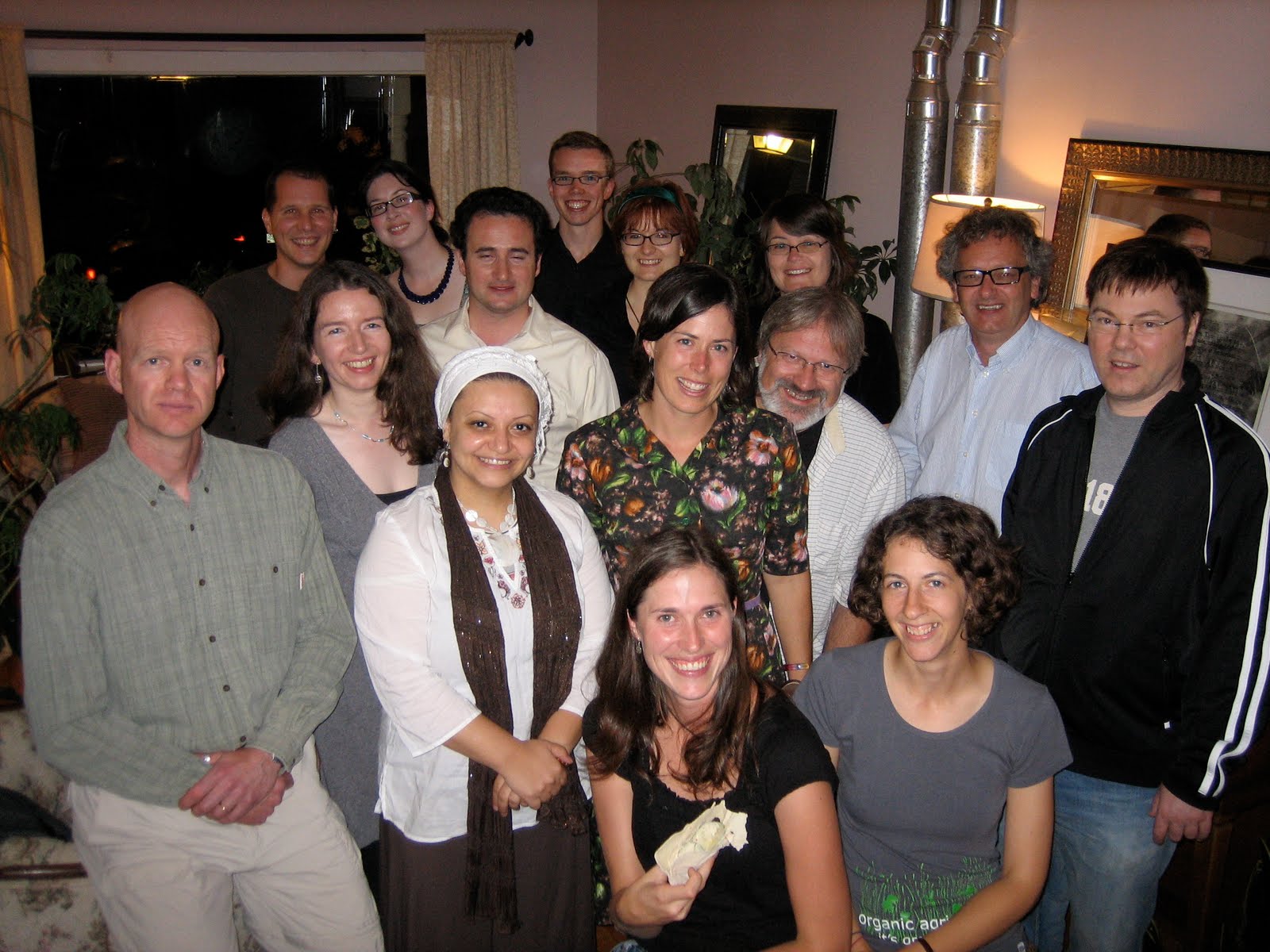
I have had a couple of social engagements this weekend, both in the "townsite" section of Corner Brook, and both with people from Grenfell. First, there was the end of Ramadan celebration (Eid ul-Fitr) on Friday night, largely in celebration of the other post-doc in the department, who is from Egypt.

The townsite area is very interesting. The houses are nice, two-story (sometimes three) and a kind of craftsman. There are only about 4 different floor plans because it's a company town and therefore, they were all built at the same time by the same crews. Isn't it weird that company towns are so oddly similar to Soviet towns? I mean, when I used to walk into an apartment in the former Soviet Union, I'd know right away the era of its design and where the bathroom was. Here it's similar, but more quaint. But the idea is the same: the company (or government) will build for you what you need, and you'll work for the company (or government). It's a socialist vision, expressed through different means. In both cases, it has disappeared, and we're dealing with something after. In the case of the company town, the previous era was called "Fordism," for obvious reasons. Henry Ford developed a system of paying his workers enough to purchase his cars. This is a story across corporate America (and Canada, I guess) in the dream time that was the early and mid 20th century. There are a lot of great stories of timber towns in Oregon where the boss would drive around, inspecting people's lawns. In Pennsylvania, mom and I met a couple from Hershey, PA who talked about the Hershey family and how it built the town of Hershey and populated it with workers and a theme park. The corporation not only employed people, it provided for them. It was paternalistic.
Our current era is being called "post-Fordism," an uninspiring and non-descriptive term. Any time someone uses the prefix post you can be sure that they're living through it, and so its immediacy makes it blurry and muddled. Our relationship with corporate governance will have some other word, later, when our fates become evident. For now, we occupy the old Fordist structures, while the mills close one by one and move to China. Meanwhile the company houses of the townsite are filled with professors. And here I am, in the "information age" of America. I often wonder what will happen when the zombies come, and I'm forced to take stock of what I can contribute to a post-post-Fordist society. I will tell the dark overlord of the Mad Max future: "Sir, I can analyze the power structure here."
Saturday, I returned to the townsite for a campus-wide eating party. I enjoyed the din of congregated, concentrated conversing, and the plates of food, and the smiley, friendly Canadians, and discussions begun by awkwardly extending a hand and saying, "Hi, I'm Erin." I've thought about trying some interesting ice-breakers, but they always seem contrived. So I stick to the geography topic: "I'm from Oregon." It's a winner here. I shall spread the tale of my beloved Oregon, a land of cowboys and loggers and hippies and the most delicious beer in the universe.
The townsite area is very interesting. The houses are nice, two-story (sometimes three) and a kind of craftsman. There are only about 4 different floor plans because it's a company town and therefore, they were all built at the same time by the same crews. Isn't it weird that company towns are so oddly similar to Soviet towns? I mean, when I used to walk into an apartment in the former Soviet Union, I'd know right away the era of its design and where the bathroom was. Here it's similar, but more quaint. But the idea is the same: the company (or government) will build for you what you need, and you'll work for the company (or government). It's a socialist vision, expressed through different means. In both cases, it has disappeared, and we're dealing with something after. In the case of the company town, the previous era was called "Fordism," for obvious reasons. Henry Ford developed a system of paying his workers enough to purchase his cars. This is a story across corporate America (and Canada, I guess) in the dream time that was the early and mid 20th century. There are a lot of great stories of timber towns in Oregon where the boss would drive around, inspecting people's lawns. In Pennsylvania, mom and I met a couple from Hershey, PA who talked about the Hershey family and how it built the town of Hershey and populated it with workers and a theme park. The corporation not only employed people, it provided for them. It was paternalistic.
Our current era is being called "post-Fordism," an uninspiring and non-descriptive term. Any time someone uses the prefix post you can be sure that they're living through it, and so its immediacy makes it blurry and muddled. Our relationship with corporate governance will have some other word, later, when our fates become evident. For now, we occupy the old Fordist structures, while the mills close one by one and move to China. Meanwhile the company houses of the townsite are filled with professors. And here I am, in the "information age" of America. I often wonder what will happen when the zombies come, and I'm forced to take stock of what I can contribute to a post-post-Fordist society. I will tell the dark overlord of the Mad Max future: "Sir, I can analyze the power structure here."
Saturday, I returned to the townsite for a campus-wide eating party. I enjoyed the din of congregated, concentrated conversing, and the plates of food, and the smiley, friendly Canadians, and discussions begun by awkwardly extending a hand and saying, "Hi, I'm Erin." I've thought about trying some interesting ice-breakers, but they always seem contrived. So I stick to the geography topic: "I'm from Oregon." It's a winner here. I shall spread the tale of my beloved Oregon, a land of cowboys and loggers and hippies and the most delicious beer in the universe.
Subscribe to:
Posts (Atom)